Handmade in Alberta: How I Turn Nature into Jewellery
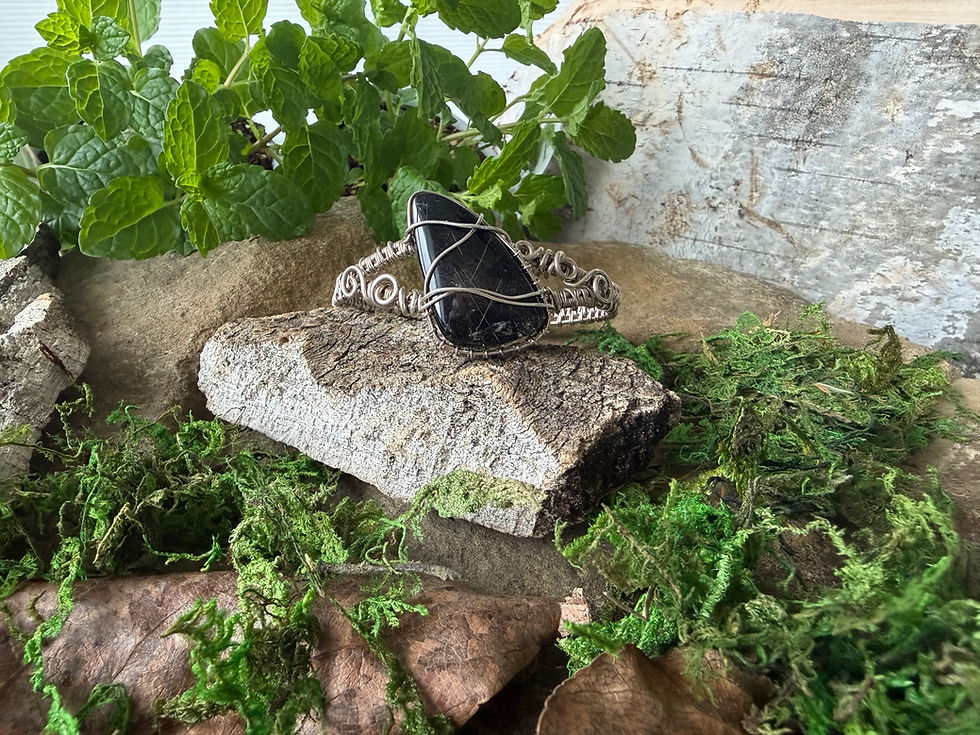
Every piece has its own inspiration. Every piece is wire-wrapped and forged by hand in my studio in Derwent, Alberta.
I live outside a hamlet called Derwent, in rural Alberta. If you've never heard of it, you're in good company — about a hundred people live here, and the nearest traffic light is a thirty-minute drive in either direction. It isn't the most obvious place to run a handmade jewellery business. But it's also exactly the right place.
This is the story of Geneen's Gift Gallery — how it started, how I make what I make, and why a small prairie village turns out to be one of the best possible places to build a business rooted in nature.
How it all started
I first started making jewellery when my children were small — just little crafts to keep tiny hands busy. We'd string beads together, weave bracelets out of cord, turn whatever was on the table into something wearable. Somewhere along the way I noticed that it wasn't only the kids enjoying it. I was too.
It took me a few more years before I circled back to that interest and started learning the craft seriously. The turn to business came later, and it came quietly. One day I was trying to organize my studio and the question of what to do with all the pieces I'd already made kept circling — they needed a home. A home with someone who would love them and wear them, and I couldn't gift them all. Around the same time, friends and family started asking me to make pieces for them. Then their friends asked. Then strangers at local markets.
At some point it stopped being "Geneen's hobby" and started being Geneen's Gift Gallery.
The name is not accidental. Geneen's Gift Gallery is a promise to myself that I will continue to be true to my creative self and also a way for me to share my passions with friends.
The work hasn't changed much since those early days. I still hunt for stones whose pattern or colour catches me. I still sit down at my workbench with copper wire and a plan that usually changes halfway through. And I still make every single piece myself, by hand, from my studio in Derwent.
Where Derwent is, and why that matters
Derwent is a small hamlet in Two Hills County, about thirty minutes north-west of Vermilion and roughly two hours east of Edmonton. My shop ships from here. On a map of Alberta, Derwent is a small dot surrounded by prairie, bush, and the sort of quiet that makes a creek audible from the road.
There's a stereotype that handmade artisan work belongs in city neighbourhoods with trendy storefronts. I understand why — most of my buyers live in cities, and city studios get foot traffic a rural hamlet never will. But rural Alberta gives me something no city studio can: the kind of space where nature is the loudest thing around.
My daily walks are through fields, coulees and treelines. When I'm designing a new piece, I'm taking cues from the actual textures of the landscape around me — the way ice forms on a creek in February, the specific green of prairie grass after a spring rain, the streaked copper-orange of a late-autumn sunset.
What "handmade" actually means here
The word handmade has been softened by marketing into something that can mean almost anything. In my catalogue, it means four specific things I do at a bench with my own two hands. I cold-forge, solder, anneal, and wire-wrap. Taken together, that is metalsmithing.
Wire-wrapping is the signature, and most of what I make is copper wire-wrapped jewellery — pendants, cuff bracelets, earrings, rings. Wire wrapping is an old technique: copper wire is shaped and wrapped, usually by hand with minimal tools, around a natural gemstone or centrepiece to frame it and hold it in place. Done well, it looks like the wire has grown around the stone rather than been forced onto it.
The other three techniques do the quieter structural work. Cold-forging is shaping metal with a hammer and an anvil, without heat — the way my Hammered copper butterfly cuff gets its faceted surface. Annealing is heating a piece of copper or silver until it softens, so I can keep working it without cracking. It never shows up in the photographs, but the piece holds together because of it. Soldering is how metal joins itself to metal — a torch, a dab of solder, a bond that should last a lifetime. All four steps often appear in a single piece.
The process, stone to finished piece
A typical piece goes through these steps in my studio.
Choosing the stone. I keep a working stash of natural stones — labradorite, unakite, amethyst, jasper, and others. No two are the same colour, vein pattern, or feel in the hand. I'll pull ten stones out of the drawer and pick the one that wants to become something.
Planning the wrap. Some stones want to be pendants, some want to be cuffs, some want to be rings. The shape and weight of the stone usually decides for me.
Cutting and shaping the wire. Solid copper wire (not plated — never plated) is cut to length and shaped with hand tools. If you look closely at a finished piece, you can see the small tool marks where I worked it. That's the signature of something made by hand.
Wrapping. This is the part that takes the longest. A single piece can take anywhere from thirty minutes for a simple design to several hours for an elaborate cuff. I don't rush it. A rushed wrap looks rushed.
Finishing. The piece gets cleaned, polished, and — for some designs — lightly oxidized to bring out the copper's character. Then it's stored, photographed, and listed for sale.
Every piece in my shop went through this, in my hands, in my studio.
Nature as raw material, not theme
On the About section of my homepage I wrote: "I take little bits and pieces of nature and create something to remind me what is important. To keep the connection alive"
That's the work, stated plainly. I go outside, pick up something small — a stone, a shell, a leaf, a piece of beach glass — and build an object around it that you can carry with you. The piece is a reminder, not a picture of one. My Green Beach Glass Copper Wire Bracelet takes sea glass and holds it in copper. My Lapis lazuli pendant is a stone with a depth of colour that is hard to photograph and harder to forget.
Earlier this month on my Facebook page I described making a pendant while thinking of water
falls — the way light hits the froth at the bottom, the water sparkling down. I ended the post: "it's more than decoration; it's a touchstone to my time spent outdoors". That's what I mean when I say the work is nature-inspired. Not themed. Carried.
One of one
My shop carries more than 170 pieces across six categories — Artwork, Bracelets, Earrings, Rings, Anklets, and Pendants — priced from about $20 to about $250, with most of the work sitting in the $35 to $80 range. Because each piece is shaped by hand at my bench, every item in the shop is effectively one of one. Even in a series of similar designs, yours is yours.
A few things come with that. Solid copper and natural stones, properly wrapped, will outlast almost anything you'd find in a mall jewellery store. Copper develops its own patina over time; the piece changes with you. And you can ask me about it. If you have a question, or you want something a bit different, or you want to commission something specific — just ask. I answer every message personally.
A small invitation
If you've read this far, thank you. It means something to know that the person on the other end of this page cared enough to learn a bit about where their piece came from.
Every piece has its own inspiration. The next one — probably a stone I haven't picked up yet — will too.
— Geneen. Derwent, Alberta